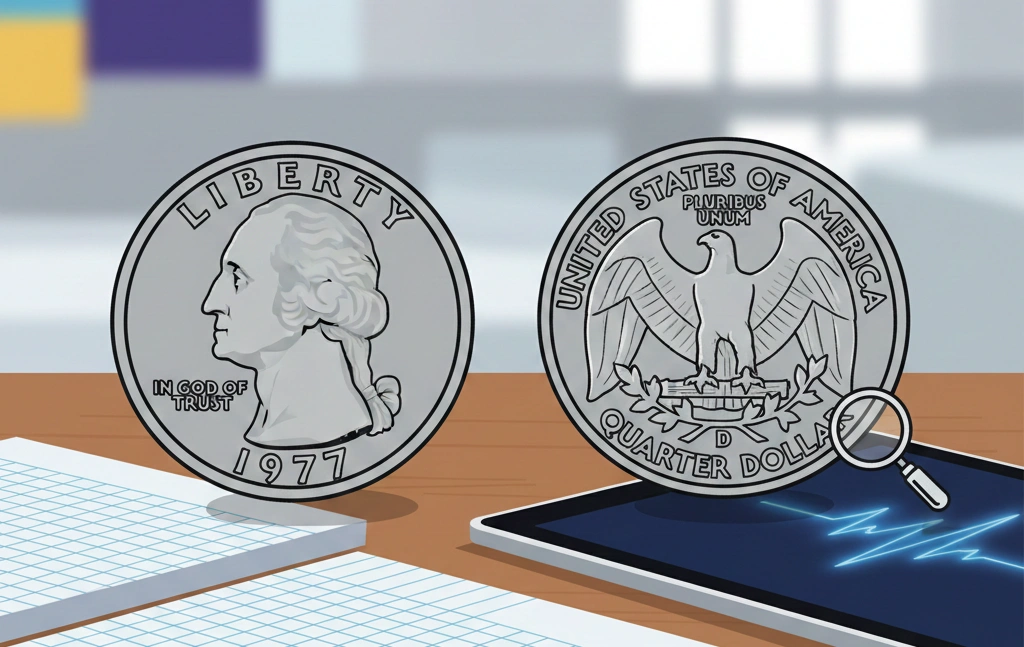
Identifying a 1977 quarter no mint mark requires an understanding of the US Mint marking system operating in the late 1970s.
This type of coin is often mistaken for a rare mint error, although the absence of a letter designation is a standard feature of the main mint's production.
the market value of such specimens ranges from face value to hundreds of dollars, being determined solely by physical preservation and strike quality.
Production Geography and Marking System
In 1977, the minting of 25-cent coins was carried out at three main facilities, each having its own marking rules.
Philadelphia: The mint mark is absent.
Denver: Marked with a "D" on the obverse.
San Francisco: Marked with an "S" (issued only in collector sets).
Thus, a 1977 coin without a mark officially confirms its Philadelphia origin.
The total Philadelphia mintage reached 468,556,000 specimens, making the coin common and accessible for study.
Visual Identification Algorithm
To locate the mint mark, one must examine the coin's obverse containing the portrait of George Washington.
Area Localization: The mint mark is situated to the right of the President's neck, below the inscription IN GOD WE TRUST.
Tools: Using a 5x loupe is recommended for eliminating the factor of heavy wear capable of erasing a letter designation.
Field Inspection: The presence of a clean metal area in the specified location indicates Philadelphia origin.
Year Verification: The year designation (1977) is located at the bottom of the obverse under the portrait.
The absence of a mark on a 1977 coin is a norm provided for by the technological process of that time.
Impact of Condition on Market Value
The price of a 1977 quarter with no mint mark depends directly on the assessment using the 70-point Sheldon scale.
Coins having traces of circulation (Circulated) are valued at their face value of 25 cents.
Grading | Value (USD) | 10-Year Increase (%) |
MS63 (Mint State) | 1.00 | +5% |
MS65 (Gem BU) | 6.00 | +12% |
MS66 | 22.00 | +18% |
MS67 | 250.00 | +35% |
MS67+ | 1,250.00 | +55% |
Statistics show a price drop of 40% upon a grade decrease of just one point below MS65.
The highest volatility is observed in the MS67+ segment, where every certified specimen triggers competition at auctions.
Top Grades
A coin reaching a grade of MS67 or higher requires a nearly perfect surface condition excluding the presence of micro-scratches.
The primary obstacle to obtaining a high score is bag marks arising from coins colliding during transportation.
Obverse: The coin field must possess an even mint luster without darkening.
Reverse: The eagle image must have full detailing of the feathers on the chest and wings.
Edge: The presence of sharp reeds without traces of impacts against other objects.
Specimens in MS67+ condition are encountered extremely rarely, constituting less than 0.001% of the total volume of verified coins.
Record Auction Sales
The history of trading records exceptional cases of 1977 quarters selling for sums many times exceeding their face value.
2021 Record: A 1977 MS67+ (PCGS) coin was sold for 1,320 USD at Heritage Auctions.
2019 Record: A 1977 MS67 specimen was realized for 450 USD.
For comparison, a 1977-D (Denver) coin in a similar MS67+ condition costs an average of 600–700 USD, indicating the greater rarity of perfect specimens from Philadelphia.
The annual price change for top grades is approximately 5.5% upward, provided the numismatic market remains stable.
Errors Mimicking the Absence of a Mark
Technical defects exist creating a false impression of a missing mint mark on Denver or San Francisco issues.
Struck Through Grease: Production grease entering the "D" letter cavity on the die results in the absence of a mark impression on the blank.
Heavy Wear: Metal erosion during years of circulation destroys fine details, including mint marks.
Alteration: Intentional filing of the mark to create a fake "rarity," detectable during microscopic examination of the coin field.
A genuine 1977 quarter from Philadelphia is characterized by an absolutely smooth field at the mark location without traces of interference.
Mintage to Survival Ratio
Despite a mintage of nearly half a billion pieces, the number of coins suitable for investment collecting is constantly decreasing.
In the 1970s, minting technologies did not provide for special protection of circulation coins against mechanical damage.
According to expert estimates, approximately 1.5% of the 1977 issue coins are withdrawn from circulation annually and sent for melting due to critical wear.
This increases the value of surviving unopened bank rolls, which may contain untouched specimens.

Investment Potential of Coins Without a Mark
Investing in standard 1977 quarters is justified only when purchasing coins having undergone grading at PCGS or a free coin identifier app.
The liquidity of uncertified coins is extremely low, as buyers avoid the risks of underestimated condition.
Entry Point: Purchasing specimens no lower than MS66 is recommended.
Holding Period: The optimal period for fixing profit is 7–10 years.
Risks: The main risk is the entry of a large number of new certified specimens from old hoards into the market, potentially lowering the price temporarily.
Comparison with Quarters of Other Issue Years
To understand the context, one should compare the 1977 rarity with other issues of the decade.
For example, a 1970 quarter with no mark has a lower mintage, but its price in MS67 grade is often lower due to less interest from Registry Set participants.
The 1977 coin occupies a specific niche as the "first year after the Bicentennial," attracting the attention of standard design researchers.
Professional Assessment Procedure
Upon finding a coin possessing exceptional luster and an absence of scratches, a series of actions should be performed:
Primary Inspection: Using a loupe to detect hidden defects on Washington's face.
Comparison: Verifying with reference images of MS67 grade coins via the coin checker app.
Packaging: Placing the coin in an individual plastic holder to prevent damage.
Submission for Grading: Using certified dealer services to transfer the coin for assessment.
The cost of grading starts from 25 dollars, making the procedure pointless for coins valued below this amount.
Identifying a 1977 quarter without a mint mark confirms its belonging to the standard Philadelphia issue.
The lack of collectible rarity in ordinary specimens is compensated for by the high value of coins in exceptional preservation (MS67+).
Thorough surface analysis and the use of professional assessment services allow for distinguishing common metal from a valuable numismatic asset.
Methodical searching among surviving stocks of 1970s coins remains a promising direction for discovering specimens with high investment potential.